Returning to What Was Taken: Creativity and Decolonising Our Practice
The poem I asked a room of psychologists to write
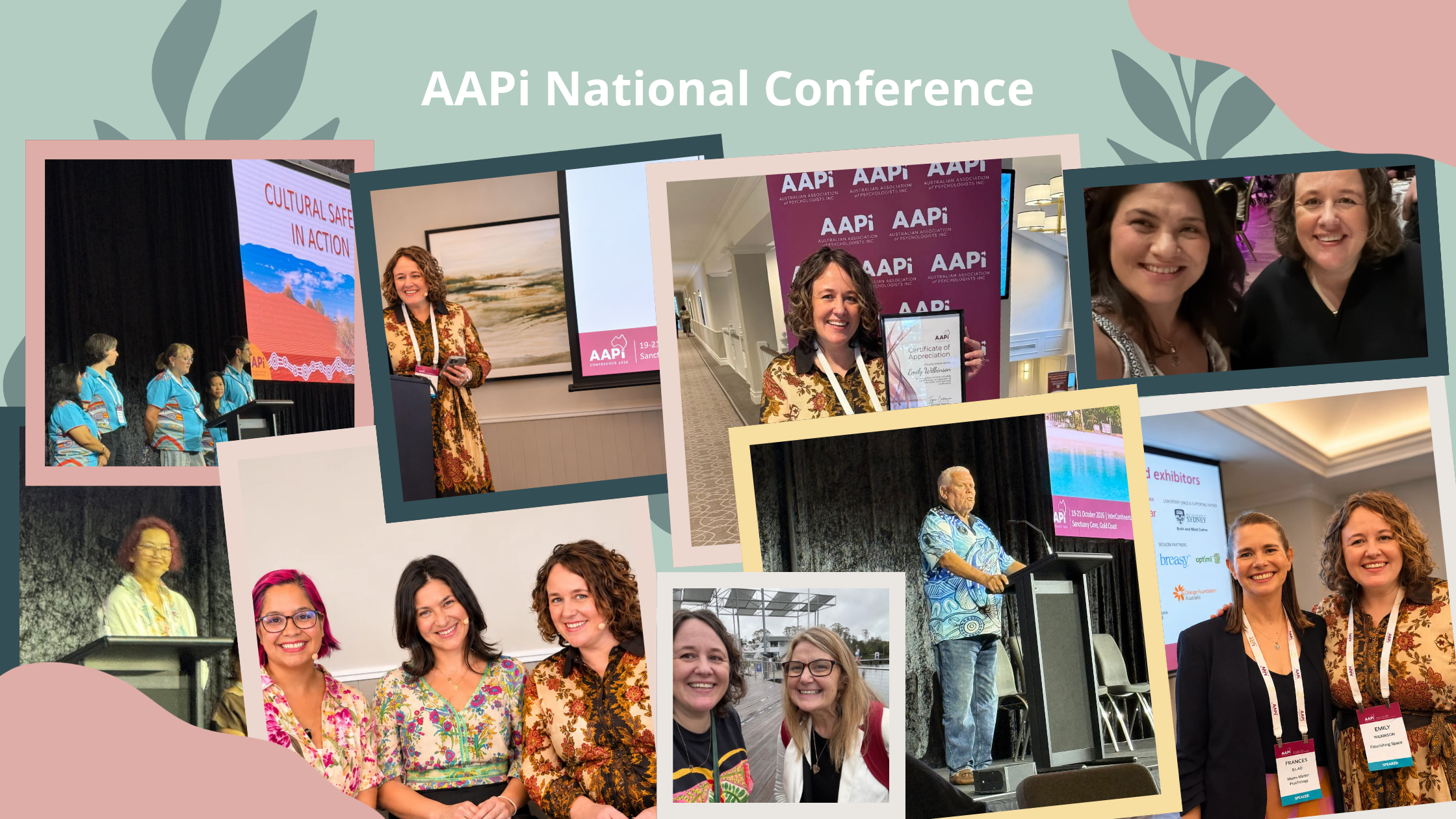
In October 2026, I stood in front of a room of psychologists at the AAPi National Conference, on Yugambeh Country on the Gold Coast, and asked them to write a poem. Before we talked about decolonisation, the evidence or the importance of creative practice in our work, I wanted us to have an experience of the expressive arts together. So I shared part of Alex Dimitrov’s poem “Love”, a list of small and vast things the speaker loves (Dimitrov, 2021). Then I invited everyone to write their own list poem made of statements beginning with “I love” or similar (e.g. “I adore” or even “I notice”). The only other instructions were to focus on process rather than outcome, and to let it be messy and uncensored. I noticed how quickly everyone in the room jumped into the exercise. It was such a special moment to witness.
Creativity is one of the things colonisation and the medical model have marginalised in our profession. Unfortunately, psychology has often contributed to this by treating the expressive arts as unscientific or unimportant. I made the case that if we want to decolonise our practice, returning to creativity, with respect for where it comes from, is part of that work.
How colonisation shapes our profession
Colonisation continues to shape psychology in ways that cause harm (Lawrence & Cook, 2026; Mullan, 2023; Selkirk et al., 2025). In Australia, the harm has been direct and devastating:
Between 1910 and 1970, tens of thousands of Aboriginal and Torres Strait Islander children were removed from their families (Human Rights and Equal Opportunity Commission, 1997). The Stolen Generations and their descendants continue to live with profound and long-term psychological, spiritual, health and wellbeing effects. Psychology is part of the system that supported the removal of Indigenous children.
The Australian Psychological Society formally apologised to Aboriginal and Torres Strait Islander people in 2016 (Carey et al., 2017). Only now does the Psychology Board of Australia’s Code of Conduct for Psychologists name cultural safety as a regulatory duty (Psychology Board of Australia, 2024).
The legacy of colonisation is built into the everyday tools, training and assumptions of our work.
Many assessment and diagnostic tools are built on WEIRD norms (drawn from Western, Educated, Industrialised, Rich and Democratic populations), yet we treat them as universal (Henrich et al., 2010). Most have not been developed with, or validated for, Aboriginal and Torres Strait Islander people (Le Grande et al., 2017). Similarly, very few Western therapeutic approaches have been tested with Indigenous populations (Pomerville et al., 2016; Ponturo & Kilcullen, 2021).
Psychology pathologises cultural difference and overlooks cultural strengths, and this continues to cause harm (Mullan, 2023).
Western psychology rests on an individualistic concept of the self. This conflicts with Indigenous ways of knowing and being, where wellbeing is understood in terms of kinship, community, culture, Country, spirit and ancestors.
Indigenous ways of being, knowing, doing and healing are pushed to the margins or labelled “alternative”, while Western approaches are simply called “evidence-based” (Lawrence & Cook, 2026). Somatic, communal, spiritual, ancestral, land-based, creative and expressive practices are devalued or left out of clinical training altogether.
Historical, intergenerational and racial trauma is often read as individual pathology, without acknowledgement of the historical or cultural context or of the need for repair (Mullan, 2023; Selkirk et al., 2025). Judy Atkinson’s (2002) work traces how trauma moves across generations through dispossession, forced removal and the loss of language and ceremony. Mullan (2023) argues that therapy can end up helping people adapt to the very systems that are harming them, which means our profession can perpetuate the trauma it claims to treat.
Decolonising ourselves and our profession is essential if we want to prevent further harm and offer care that is effective, culturally safe and responsive.
What creativity offers
The World Health Organization’s scoping review drew on more than 3,000 studies and found that arts engagement supports health and wellbeing across a wide range of outcomes (Fancourt & Finn, 2019). Creative and arts-based approaches may help people access preverbal and embodied experiences of trauma, and can support emotional processing in a way that feels less threatening than talking alone (Malchiodi, 2020). They can also make therapy more accessible for clients who are culturally, linguistically or cognitively diverse, neurodivergent, non-verbal, or living with dementia, aphasia or alexithymia (Fancourt & Finn, 2019; Malchiodi, 2020).
Even with this evidence, creative and diverse ways of knowing and healing remain on the edges of mainstream psychology. I think that tells us something about whose knowledge our profession has learned to trust.
Here in Australia, the Aboriginal and Torres Strait Islander Social and Emotional Wellbeing (SEWB) framework describes wellbeing as interconnected relationships with body, mind and emotions, family and kinship, community, culture, Country and land, and spirit, spirituality and ancestors, all shaped by structural determinants (Gee et al., 2014). As practitioners learning from frameworks like this, our task is to follow the lead of the people and communities who hold them.
Holding the benefit and the source
Returning to creativity comes with responsibility. As Lawrence and Cook (2026) remind us, many arts-based approaches carry cultural origins and depth that can be lost when we adapt them for clinical use. Music and drumming, dance, beading and weaving, painting, mandala-making, mask work, yarning and storytelling all come from somewhere and belong to someone (Lawrence & Cook, 2026). Traditional crafting, for example, can carry intergenerational connection and wellness for Indigenous women and their communities (Sydora et al., 2023). Before I bring a practice into my work, I ask where it came from and whose it is. Reclaiming creativity means acknowledging both the benefit and the source.
This question is personal for me too. For a long time I kept my life as a poet separate from my work as a psychologist. What changed was realising that many of the people I worked with, especially those who had experienced trauma or grief, had been disconnected from meaning, joy, play and creativity. These are often the very experiences that make life feel worth living, yet they can become difficult to access when someone has experienced trauma or spent years in survival mode. As I connected this to my own experience, it no longer made sense to keep poetry in one part of my life and psychology in another. Instead, I began to see creativity as part of what helps us reconnect with ourselves, our communities and our capacity to heal and flourish.
Good intentions aren’t enough
Most of us come to this work wanting to decolonise our practice and to help our clients feel better. Those intentions matter, but they are not enough on their own (Lawrence & Cook, 2026; Mullan, 2023; Tuck & Yang, 2012). Some ways we can begin include:
Decolonising ourselves through ongoing inner work
Deep listening, curiosity and cultural humility
Staying present with grief, shame, blame, anger and rage
Using creative practices with respect for their origins
Following Aboriginal and Torres Strait Islander leadership and advocating for structural change
None of these replace recognising sovereignty or returning land. Tuck and Yang (2012) remind us that decolonisation is not a metaphor. The work is also continuous and evolving, and the Code of Conduct now names ongoing critical reflection on our practice as part of cultural safety (Psychology Board of Australia, 2024).
An invitation
If you’d like to start somewhere small, try the exercise I offered at AAPi. Take a few minutes to write a list of statements that begin with “I love”, and let it stay messy and unedited. Then choose one creative practice you use with clients and ask yourself where it came from and whose it is.
I’ve also written a companion guide to the talk with further reading and reflective prompts. You can find the companion guide to my 2026 AAPi Conference presentation here.
References
Atkinson, J. (2002). Trauma trails, recreating song lines: The transgenerational effects of trauma in Indigenous Australia. Spinifex Press.
Carey, T. A., Dudgeon, P., Hammond, S. W., Hirvonen, T., Kyrios, M., Roufeil, L., & Smith, P. (2017). The Australian Psychological Society’s apology to Aboriginal and Torres Strait Islander people. Australian Psychologist, 52(4), 261–267. https://doi.org/10.1111/ap.12300
Dimitrov, A. (2021). Love and other poems. Copper Canyon Press.
Fancourt, D., & Finn, S. (2019). What is the evidence on the role of the arts in improving health and well-being? A scoping review (Health Evidence Network Synthesis Report No. 67). WHO Regional Office for Europe.
Gee, G., Dudgeon, P., Schultz, C., Hart, A., & Kelly, K. (2014). Aboriginal and Torres Strait Islander social and emotional wellbeing. In P. Dudgeon, H. Milroy, & R. Walker (Eds.), Working together: Aboriginal and Torres Strait Islander mental health and wellbeing principles and practice (2nd ed., pp. 55–68). Australian Government Department of the Prime Minister and Cabinet.
Henrich, J., Heine, S. J., & Norenzayan, A. (2010). The weirdest people in the world? Behavioral and Brain Sciences, 33(2–3), 61–83. https://doi.org/10.1017/S0140525X0999152X
Human Rights and Equal Opportunity Commission. (1997). Bringing them home: Report of the National Inquiry into the Separation of Aboriginal and Torres Strait Islander Children from Their Families. https://humanrights.gov.au/our-work/bringing-them-home-report-1997
Lawrence, M., & Cook, A. (2026). Decolonizing mental health in Australia. In B. Bennett & J. Prehn (Eds.), Aboriginal social work voices (pp. 273–298). Bloomsbury Academic.
Le Grande, M., Ski, C. F., Thompson, D. R., Scuffham, P., Kularatna, S., Jackson, A. C., & Brown, A. (2017). Social and emotional wellbeing assessment instruments for use with Indigenous Australians: A critical review. Social Science & Medicine, 187, 164–173. https://doi.org/10.1016/j.socscimed.2017.06.046
Malchiodi, C. A. (2020). Trauma and expressive arts therapy: Brain, body, and imagination in the healing process. Guilford Press.
Mullan, J. (2023). Decolonizing therapy: Oppression, historical trauma, and politicizing your practice. W. W. Norton & Company.
Pomerville, A., Burrage, R. L., & Gone, J. P. (2016). Empirical findings from psychotherapy research with Indigenous populations: A systematic review. Journal of Consulting and Clinical Psychology, 84(12), 1023–1038. https://doi.org/10.1037/ccp0000150
Ponturo, A., & Kilcullen, M. (2021). A systematic review of evidence-based psychological interventions and Aboriginal and Torres Strait Islander people. Clinical Psychologist, 25(2), 198–211. https://doi.org/10.1080/13284207.2021.1934429
Psychology Board of Australia. (2024). Code of conduct for psychologists. Australian Health Practitioner Regulation Agency. https://www.psychologyboard.gov.au/Standards-and-Guidelines/Professional-practice-standards/Code-of-conduct.aspx
Selkirk, B., Alexi, J., Hirvonen, T., & Dudgeon, P. (2025). Embracing social and emotional wellbeing can create transformational change in psychology. In S. Bhatia, J. S. Fernández, & C. C. Sonn (Eds.), Decolonial psychology: Academic and activist perspectives (pp. 13–29). Taylor & Francis Group.
Sydora, B. C., Listener, L., Kung, J. Y., Ross, S., & Voyageur, C. (2023). Traditional crafting as a catalyst for Indigenous women’s intergenerational cohesion and wellness: A Canadian perspective. International Journal of Circumpolar Health, 82(1), 2175763. https://doi.org/10.1080/22423982.2023.2175763
Tuck, E., & Yang, K. W. (2012). Decolonization is not a metaphor. Decolonization: Indigeneity, Education & Society, 1(1), 1–40.
Ready to explore more ways to flourish in work and life?
The waitlist for The Flourishing Way is currently open! This program brings together psychological and mindfulness-based approaches with hands-on creative exploration. It’s designed to help you reconnect with the vibrant, playful parts of yourself and flourish in work and life. Learn more here.
Or if you’d like to explore further ways to nurture your creativity, experience more creative flow and build a flourishing life, you can learn more about my services here.
Is this post the kind of thing you love exploring? I’d love to hear from you. You can connect with me on Instagram @the_flourishing_space or on LinkedIn.
